

Bugdozer is the first of many mini sumo bots that I’ve built over the years. My current champion is Number Two, but Bugdozer will always have a special place in my heart.
In 2000, to push myself into really learning robotics, I made a personal goal of competing in Central Illinois Robotics Club’s (CIRC) Second Annual Robotics Competition.

For the couple of months leading up to the contest, I prototyped and built an entry in the smallest class of Sumo bots. To learn more about Robot Sumo contests, see the Illustrated Guide to American Robot Sumo.

No bug is too small for Bugdozer!
I felt as if I could finish and enter even a single decent robot with these qualifications and standards that I would be satisfied with my progress as a robot hobbyist. In laboratory test trials, on Saturday, October 7, 2000, 7:45 PM CDT, Bugdozer demonstrated it met and exceeded these expectations.


Views of Bugdozer’s body

An MC68HC908GP32 running at 8 MHz. Several kilobytes of hand-coded assembly and data attack tables. Plenty of support chips for I/O, voltage regulation, motor H-bridge driving, and 38-kHz carrier wave generation.
Click here for more about Bugdozer’s motherboard...
Approximately 493 grams.

Bugdozer’s width and a milk-chocolate M&M’s candy for size reference
Just barely under 10 centimeters at the tires.
Around 9.5 centimeters at the front scoop.

Bugdozer’s depth
Almost exactly 10 centimeters from scoop to rear of tire. (The photograph angle gives the illusion of its behind exceeding 10 cm)

Bugdozer’s start button
The red button on the motherboard starts the five-second countdown to combat. The front sensor lights flash on and off every second to show the robot is under starter’s orders.

The vicious wooden monster
The original test was to beat a 1/2-pound block of wood. Well, look out for this nasty opponent who tips the scales at over a pound. That’s a lot of wood!
Click here for videos of Bugdozer in test runs...

Red ultra-bright emitters and near-red phototransistors for Sumo line border detection
Gloss bright white lines trim the edge of the Sumo ring. To insure Bugdozer doesn’t accidentally stray out of bounds, four ultra-bright red LEDs and five near-red phototransistors detect lines in front of and behind the robot.
Click here for close ups of the line detectors...

Side painted black to avoid being seen
Three design features are implemented to avoid being hit on the side:
Click here to see details of the body design...
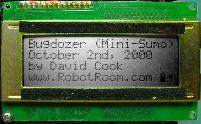
Text LCD panel
For debugging and testing, Bugdozer has an LCD panel. A lot of cool data is collected and displayed. An onboard panel is much easier to use than a wired or infrared computer connection.
Because it would lead to qualification violations, the LCD panel isn’t used during competitions. Specifically, the width of the panel (as it fits onto the connector on the robot’s motherboard) hangs beyond the 10 centimeter limit. Also the panel adds considerable weight, about 60 grams (2.1 ounces). The weight is placed in the back, which is a bad spot as it tends to make the robot more likely to tip backwards.
Click here for screen shots of Bugdozer’s LCD...
Next, let’s see how Bugdozer’s aluminum sheet body was made...
