Machining is becoming a lost art.
Many people panic when a small part breaks and a replacement is unavailable.
However, you can buy a small mill/drill machine or a mini lathe to turn scrap metal (aluminum, brass, and mild steel) into custom parts in your basement or garage.
The ability to create your own parts is particularly helpful in robotics.
The most important decision is choosing the right tool or machine for the job.
Next, how do you hold the workpiece securely, so that it won’t break the tip of the cutting tool and metal won’t fly across the room?
Lastly, what order do you perform the cuts and what measuring devices can you use to machine the part most accurately?
When I first started building robots, I had no machining experience at all.
Over time, I’ve tried to write my machining tips and suggestions, as well as mistakes, in the articles throughout this website.
Making metal and plastic parts is one of the most freeing and satisfying experiences I’ve ever undertaken.
 Machining Parts for Friends
Machining a child safety gate clamp, a bolted bracket for a satellite radio,
a LEGO shaft motor coupler, a compression tube nut, vise jaws for holding PCBs, and a brass lathe carriage lock.
 Prototype Plastic
Making shapes and bonding materials using ShapeLock low-temperature melting plastic.
Melts in the oven, on a griddle, or in hot water.
Reuse the material or scraps.
 Weatherproof Project Box
Modifying a Pelican micro-case for a dustproof, waterproof, and bugproof outdoor electronics container.
Tips on punching a rubber liner and connecting external wires through a PVC pipe, or hacking a seal with poster tack.
 3D Printed Spool and Wire Soldering Holder
Buying new wire begs the question of what type of insulation to choose.
PTFE is selected since it doesn't tend to melt back as common PVC wire insulation does.
The new wire arrives without a spool, which necessitates printing a spool on a three-dimensional printer.
The spool is easy enough to model but consumes the day with a six-hour print time.
Soldering the newly acquired wire to another wire is frustrating with the classic misaligned 'helping' hands tool.
Thus, old-fashioned wooden clothes pin attached to a base become the project being worked on rather than whatever I needed that wire for in the first place.
 How *Not* to Cast and Machine Bismuth
Bismuth is a high-density non-toxic metal that forms beautiful crystals.
Well, supposedly it forms beautiful crystals, just not for me.
See examples of clay casting failures and chipped surfaces as I muddle my way through trying to make anything out of bismuth.
 Soda Pop Top Cleaner
Have you ever received an aluminum can with gunk in the groove on the top? Ick! Gross!
This device is intended to push a paper towel firmly into the unreachable crevices, so that the can can be cleaned with a simple twist.
The article describes using a wax mold to determine the proper dimensions and using the compound on the lathe to cut the angle.
 Low-Cost Tips to Prevent Rust in Your Home Machine Shop
Plastic containers, cut-to-length tubing, and silica gel packets are inexpensive ways to protect your drill bits, end mills, metal taps, and other cutting tools against damage from rust and tool-to-tool contact.
However, a dehumidifier may not be the best approach.
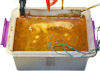 Electrolysis Rust Removal
There’s nothing more depressing than to see corrosion on your precision tools or antique hardware, particularly if the rust is in a hard to reach area.
Fortunately, there’s an electrical technique to reverse oxidation without harming steel or iron the way abrasives or harsh chemicals can.
Includes results of testing a graphite electrode for the anode.
 Digital Caliper Data Port
Most digital calipers include a port that outputs the caliper position as a digital signal.
Let where to buy inexpensive calipers, how to interface to them, and how to read several of the protocols.
 Caliper Capacitor
To avoid replacing batteries, attach a device to an external power source.
But, that can result in operational problems due to electrical noise.
Adding a capacitor to the battery compartment can fix that.
See an example where an LR44 battery is replaced in a digital caliper.
 Digital Indicator
Reuse is a good thing. In this case, a unique surplus item that appears to be a digital caliper is actually a digital indicator based on the caliper body and circuitry.
The data port pinouts, mounting screw sizes, and example output analysis are posted, along with a cheap way of powering the tool from a 'AA' cell.
 Straightening Screws, Bolts, or Rods
In the event that a bent part can’t be replaced, here is a technique for fixing a bent piece by carefully applying torque with a steel pipe while the part is held in a vise.
 Finding the Center of a Circle
There’s a simple method for finding the center of a square, circle, or octagon.
The technique is useful if you’re making your own wheels.
Two lines drawn at a 45-degree angle to two different sides will cross in the center.
Perhaps the described tool and pictures will make it clearer.


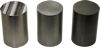 Machining Magnesium for Elemental Density Comparison
 Making a Brass Face Plate and Brass Pushbuttons