Robots and electronic projects rely of a variety of sensors for input from the real world.
Light sensors, whether visible or infrared, are particularly helpful.
These electronic sensors have a variety of names, usually with the prefix “photo”:
 Replacement for PNA4602M
The Panasonic PNA4602M 38-kHz infrared detector was a very popular electronic part for obstacle and wall detection.
Unfortunately, the PNA4602M is discontinued and similar modules can’t handle continuous signals.
Good news! The new Vishay TSOP4038 is an excellent substitute.
Tests compare detection distance, false pulses, and detection time.
Also included is the relevant source code to variable-frequency duty-cycle measurement.
 Testing Materials for Infrared Transparency using a Remote Control
Most robot light sensors are infrared (IR) based. As such, what they see may be very different than what you see in visible light.
Here are some simple tests that you can perform on materials using a remote control to determine if the material is opaque or transparent to infrared.
Bonus: David attempts to paint plastic to see if more IR can be blocked.
 Thermal Imaging
Infrared pictures and images can reveal energy waste, health issues, security codes, animal behavior, and circuit board flaws.
It is also a great way to cheat at hide-and-go-seek.
Take look at a gallery of fascinating thermal images taken with the Flir E4 infrared camera.
Additionally, there is a video of a power-supply heating up, as well as desoldering wires.
 Laser Detection Sensor and Memory
Although IR and wireless remotes are common, it is also possible to construct a sensor circuit that is activated with a laser pointer.
A modern TLV3702 comparator chip compares a trip-level potentiometer voltage to a photoresistor sensor voltage.
The result is connected to a 74AC74 D-type flip-flop that remembers the last state, which is indicated on a large blue LED.
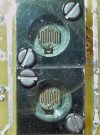 Polarized Light Beacons and Photosensors
Linear polarizing filters can be placed over light sources to act as beacons.
By placing a pair of orthogonally-oriented polarized films over ordinary photosensors, the robot can distinguish between two different beacons.
This can be useful for robot contests or for navigating between a destination and a charging station.
 38-kHz Infrared Emitter Revisited
Infrared LEDs are commonly used for object detection in robots.
Blinking the LED on and off 38,000 times a second improves long-range detection and reduces false triggers.
Pictures, comparisons, and a schematic demonstrate a simple, reliable, low-power 555 CMOS circuit.
 Generating Waveforms with Paper Discs
In a pinch, you can generate square, sawtooth, sinusoidal, triangular, and noisy/static waveforms by playing a patterned disc on a record player or spare motor using a light sensor.
An LED illuminates the paper disc, which reflects varying amounts of light into the light sensor as the disc rotates on the turntable (see the video for a demonstration.)
The circuitry is fairly simple and uses commonly found parts.
Can you guess the waveform generated by the thumbnail image?
 Color Sensor for Robot
I experimented with developing a simple, active, color, object sensor for my robots based on three ultra-bright LEDs or a single RGB LED.
An old-fashioned cadmium-sulfide sensor or modern TAOS light-to-voltage converter detects the brightness of the reflected red, green, and blue as each is turned on individually.
 Reverse an LED to Make a Color Photosensor
Surprisingly, if you put an LED in backwards and amplify the signal with an op amp, you can create a color sensor as though the LED were a photodiode.
This article shows how to improve the signal quality with multiple LEDs, provides tips on reducing electrical noise, show how to convert the output to a digital signal,
and includes a schematic and breadboard photo to help you implement the circuit.


 Testing the Sharp GP2D12 Infrared Distance Measurement Sensor
 Cadmium-Sulfide Photocell Grab Bag